

The development of water-based acrylic resin!
Date:
2021-11-25
Water-based acrylic resin is a new field of polymer disciplines, foreign research began in the 1970 s, due to the water-based resin has the advantages of environment-friendly, safe and easy to obtain, convenient construction, wide coverage and other advantages, some products have been gradually industrialized. Water-based resin is a new type of resin system with water instead of organic solvent as dispersion medium. Polymer resin is dispersed in water, which can be arbitrarily mixed with viscosity suitable for processing and form metastable liquid.
Water-based acrylic resin is a new field of polymer disciplines, abroad in the 1970 s, began to study, due to the water-based resin has the advantages of environmental friendly, safe and easy to obtain, convenient construction, wide coverage and so on, some products have been gradually industrialized. Water-based resin is a new type of resin system with water instead of organic solvent as dispersion medium. Polymer resin is dispersed in water, which can be arbitrarily mixed with viscosity suitable for processing and form metastable liquid.
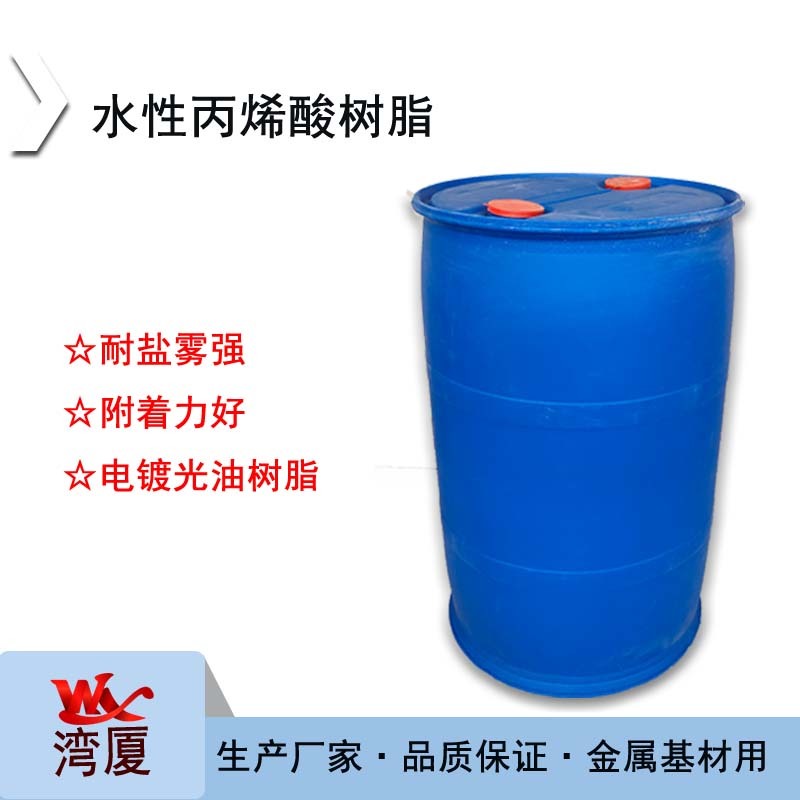
The research focus of water-based acrylic resin is to obtain film-forming materials with excellent physical properties after water volatilization, so as to achieve "water-based resin water-insoluble" and overcome the factors such as high surface tension and high specific heat capacity brought by water medium, which are not conducive to coating processing. Water-based coatings can reduce environmental pollution and have been used in many fields such as construction, automobiles, wood, ink, home appliances, fabrics, etc.
Acrylic water-based paint can be divided into water dispersion and water-soluble two categories, the former is based on water emulsion or hydrosol as the matrix coating. Water-soluble acrylate coatings are made of copolymer resins with active cross-linkable functional groups, and multi-series thermosetting coatings are used to add or not cross-linked resins during the paint making process, so that the active functional groups are cross-linked during the film formation to form a paint film with a type structure. The development of water-based acrylate coatings can ensure the performance of acrylate coatings under the conditions of a variety of unique, most of the organic volatile solvents replaced by water, so as to achieve a significant reduction in air pollution purposes.
Water-soluble acrylic resins are mostly anionic. The monomers of the copolymer resin are selected from the appropriate amount of unsaturated carboxylic acids such as acrylic acid, methacrylic acid, maleic anhydride, methylene succinic acid, etc., so that the side chain has a carboxyl group, and then the organic amine or ammonia water is neutralized to obtain water solubility. In addition, the water solubility of the resin can be increased by selecting appropriate monomers to introduce hydrophilic groups such as-OH hydroxyl,-CONH2 amido or-O-ether bonds on the side chain of the resin. Neutralization of the salt of acrylic resin can be dissolved in water, but its water solubility is not very strong, often form a milky liquid or high viscosity solution, so in the water-soluble resin must be added a certain proportion of hydrophilic cosolvent to increase the water solubility of the resin.
Waterborne acrylic resin, water-based resin
Previous Page
Related News

Focus on us

WEB
24-hour customer service hotline
Address: 501, 502 and 601, Building 4, Phase 2, Beijiao Qide Real Estate Park, Shunde District, Foshan City, Guangdong Province
Telephone:+86-757-23622292
Mobile:+86-13827784647
E-mail:wanxia_sd@163.com